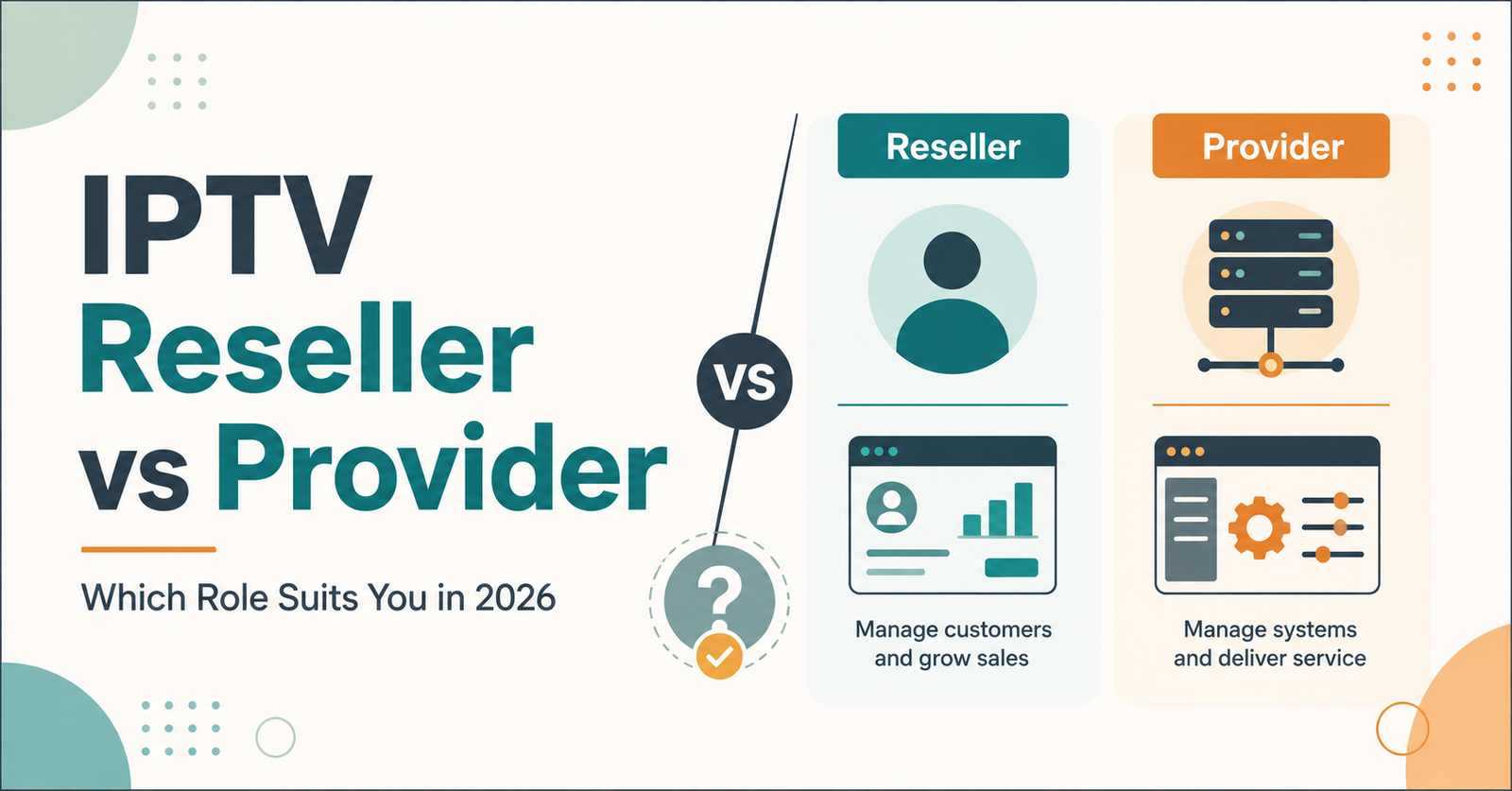
IPTV Reseller vs Provider comes down to a simple structural difference: a reseller buys credits or lines from someone else’s platform and sells access under their own brand, while a provider owns and operates the underlying panel, servers and content delivery infrastructure. Most people asking this question are trying to work out which side of that line they are actually on, or which one they should be aiming for. If you are selling subscriptions to friends, local contacts or a small growing customer base, you are almost certainly operating as a reseller rather than a provider, regardless of what a supplier’s marketing calls itself.
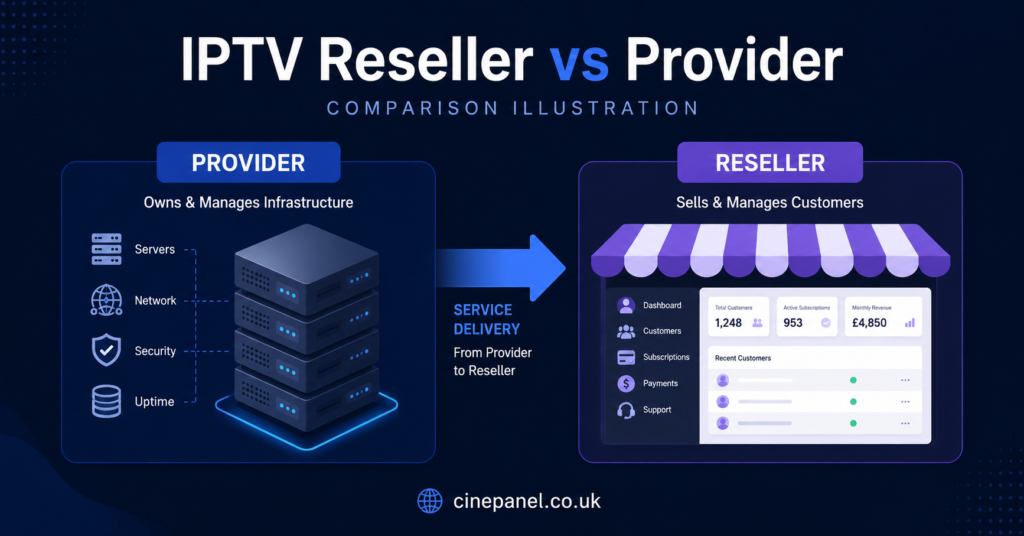
IPTV Reseller vs Provider Explained
A provider is the party running the technical stack: panel software, streaming infrastructure, content agreements and server capacity. Everything downstream, including how smoothly a customer’s stream performs on a Saturday evening, depends on decisions the provider makes about uptime, catalogue refresh and device compatibility.
A reseller sits one layer above that. Instead of running servers, a IPTV Panel reseller buys credits, opens customer lines through a dashboard, sets retail pricing and handles the day to day relationship with subscribers. The reseller never touches the infrastructure directly. Their job is commercial rather than technical, and that distinction matters more than most sales pages admit.
What a Provider Actually Owns and Manages
A genuine provider is responsible for server capacity and bandwidth, licensing agreements for the content it distributes, the panel software resellers log into, catalogue maintenance, and technical escalation when something breaks at the infrastructure level. Running this side of the business means ongoing hosting costs, support staffing, and legal exposure that scales with every customer added anywhere in the reseller chain beneath it.
What a Reseller Buys and Controls
A reseller buys access, usually in the form of credits, and controls the parts of the business a customer actually sees: retail pricing, branding, trial length, renewal timing and the tone of support conversations. None of this requires server knowledge. It does require consistency, because a reseller’s reputation lives or dies on how quickly they answer a message and how honestly they set expectations before a sale.
| Factor | Reseller | Provider |
|---|---|---|
| Owns infrastructure | No | Yes |
| Sets retail price | Yes, freely | Usually wholesale only |
| Handles day to day licensing compliance | Only for their own resale conduct | Fully responsible for source agreements |
| Main upfront cost | Credits, bought as needed | Servers, panel software, ongoing hosting |
| Support role | Frontline for their own customers | Backend and technical escalation |
Where the Money and Risk Really Sit
Reseller margin comes from the gap between wholesale credit cost and retail price, and that gap can be substantial once a customer base is steady. The trade-off is dependency: a reseller’s business is only as reliable as the provider behind it, so a provider having a bad week becomes the reseller’s problem too, often before the reseller even knows why.
Provider-side economics look different. Margins can be wider per customer, but so is the exposure. Server costs, transcoding capacity and support staffing don’t shrink just because a quiet month arrives, and licensing obligations sit with the provider regardless of how many resellers are reselling underneath them.
Pro tip: Before committing to either role, ask a prospective supplier exactly what happens to your customer base if their panel goes down for a weekend. The answer tells you more about their reliability than any uptime percentage on a pricing page.
Signs You Might Be Ready to Move From Reseller to Provider
Renewal volume that has stayed predictable for several consecutive months is one indicator. Wanting a fully white-label app rather than a generic player is another. So is reaching a point where wholesale credit costs, even on a discounted band, start eating into margin more than running your own infrastructure would.
Pro tip: Model a full year of provider-level running costs, including hosting, support staffing and licensing overhead, against a full year of reseller-level margin before switching. Comparing against one good month will make the provider side look more attractive than it usually turns out to be.
Common Mistakes People Make Comparing the Two Roles
A lot of confusion in this space comes from marketing rather than reality. Some suppliers call themselves a provider purely for positioning, when what they actually offer is a reseller panel built on someone else’s infrastructure further up the chain. Others treat credit cost as the entire cost of running a reseller business, forgetting payment processing fees, time spent on support, and the customer churn that comes from a poorly managed trial process.
Underestimating support demand is another common error. A handful of customers is manageable in a group chat. Fifty customers with staggered renewal dates is not, and that gap catches a lot of new resellers off guard within the first few months.
A UK reseller dashboard like Cine Panel is built specifically for the reseller side of this split, which is worth knowing before assuming every panel on the market is trying to be a full provider stack. Understanding how credit bands actually affect margin is also easier once you’ve looked at published credit pricing directly rather than estimating from a sales call.
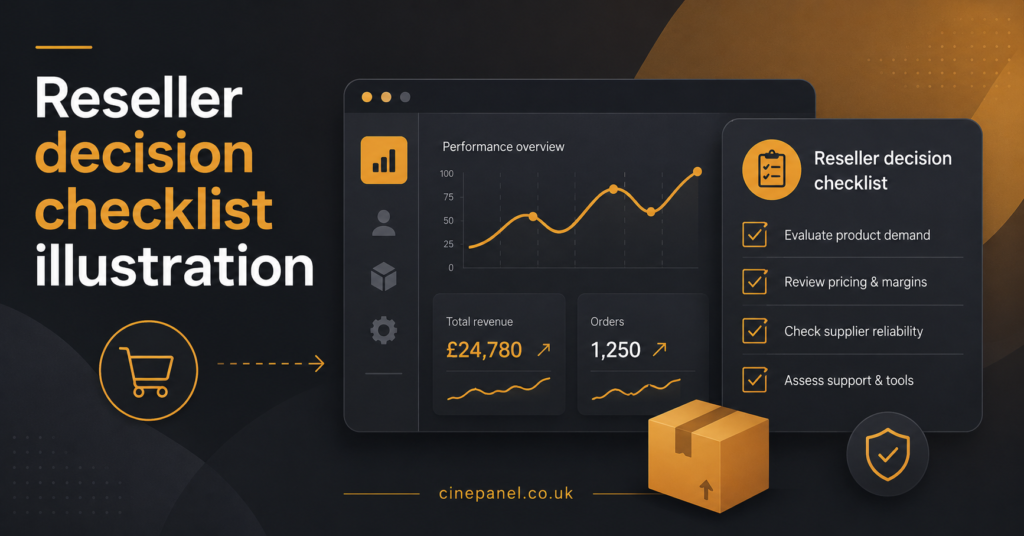
Reseller Decision Checklist
- Confirm whether the supplier is genuinely a provider or itself a reseller one level up
- Check what happens to unused credits if a month goes quiet
- Test a trial line yourself during peak evening hours before selling to anyone
- Read the supplier’s terms on licensing responsibility before assuming it sits with them
- Work out your break-even customer count at the credit band you’re actually buying
IPTV Reseller Questions, Answered
Is an IPTV reseller the same as an IPTV provider?
No. A reseller buys access and manages customers under their own brand. A provider owns the infrastructure and content agreements behind that access.
Do resellers need technical skills to get started?
Not usually. Most reseller dashboards are built so that opening a line, setting a price and managing renewals requires no server knowledge at all.
Can a reseller become a provider later on?
Yes, though it usually means taking on hosting costs, licensing responsibility and technical support obligations that a reseller role doesn’t carry.
Who is responsible for content licensing, the reseller or the provider?
This depends on the supplier’s terms, but licensing obligations typically sit with whoever controls the underlying content agreements, which is usually the provider.
Is it cheaper to start as a reseller or as a provider?
Starting as a reseller is almost always cheaper, since it avoids server, hosting and licensing overhead in exchange for buying access as needed.
IPTV Reseller vs Provider is, in the end, a question of what you actually own and what you’re prepared to be responsible for. Most people beginning in this space are better served starting as a IPTV panel reseller, learning the commercial side of customer management and renewals before ever considering the cost and liability that comes with running infrastructure directly. If you’re evaluating a supplier right now, spend less time on how they describe themselves and more time confirming what they actually control behind the login screen.