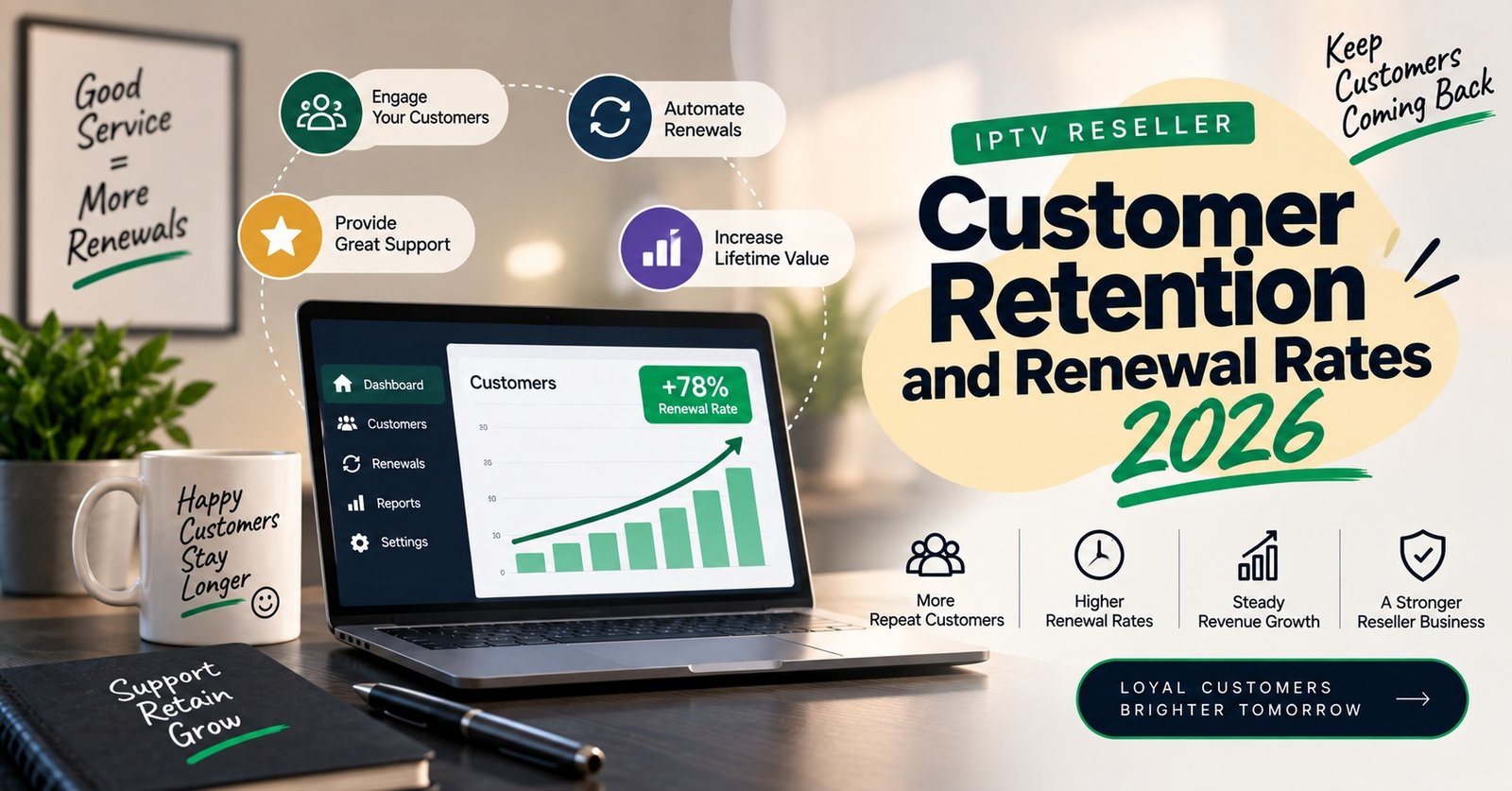
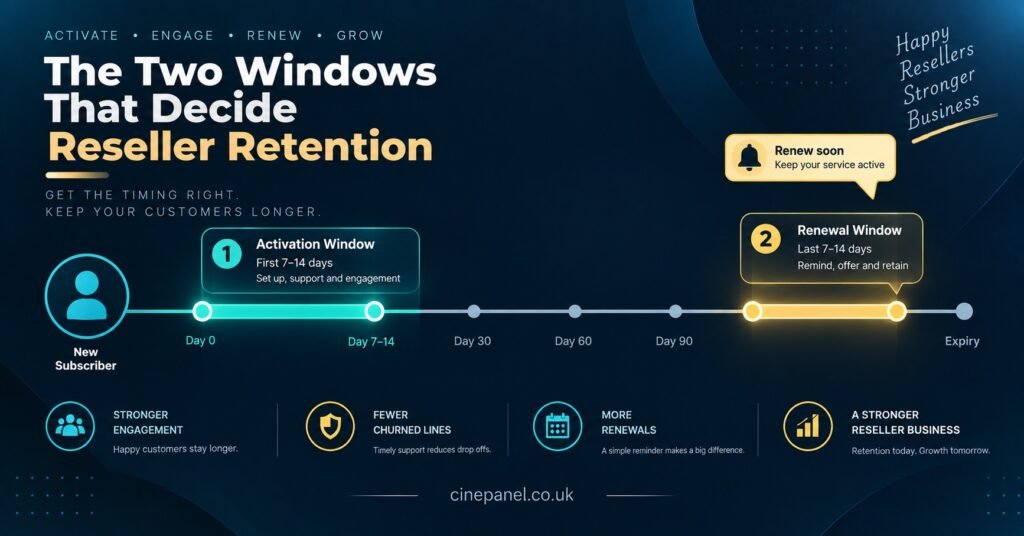
IPTV Reseller Customer Retention is decided in two short windows: the first few days after a line is activated, and the week either side of the expiry date. Price sits well below both. A subscriber who was set up properly, who knows exactly who to message when a stream stalls, and who gets a reminder before the service cuts out will usually renew without asking for a discount. One who had to work out the app on their own, waited two days for a reply, and discovered the expiry only when the screen went blank is already comparing sellers.
Before buying another batch of credits, open your expiry list and count how many lines went dead in the past month without a single message from you. That figure, rather than your advertising spend, is usually where the next month’s growth is sitting. Plenty of IPTV panel resellers spend their energy replacing customers they never actually lost on quality.
Where Subscribers Actually Decide To Leave
Churn rarely happens on the day someone stops paying. The decision is made earlier, usually at one of four moments, and by the time the line expires the customer has already mentally moved on.
The first is the setup itself. If the app, the login details and the device combination take more than one attempt, the buyer starts the relationship with doubt.
The second is the first real fault. Not a permanent outage, just a stall during something they wanted to watch. What matters here is not whether you fixed it, but whether they knew you were dealing with it.
The third is a household change. A new television, a house move, a second person wanting access at the same time. Any of these creates a moment where the customer has to contact someone. If that contact is awkward, they use the moment to shop around instead.
The fourth is the expiry date. Silence in the days before renewal reads as indifference, and indifference makes switching easy.
Notice that only one of those four is technical. Retention work in this business is mostly communication work, which is good news, because communication is the part you fully control.
The First Week Matters More Than The Price You Charged
A cheap line that the customer cannot get working is worth nothing to them. Most early cancellations and refund requests trace back to a setup that was handed over without context.
Onboarding does not need to be elaborate. It needs to be consistent. Send the credentials in a format the customer can actually use on the device they own, confirm which app you have configured them for, and tell them plainly how many simultaneous connections their line allows. That last point prevents a surprising number of support tickets later, because a customer who does not know their connection limit will assume a fault when a second device refuses to play.
Set Expectations Before The First Stream
Honest framing at the point of sale protects you for the whole subscription. Tell buyers what depends on their own connection, what happens during a busy evening, and what you can and cannot fix from your side. IPTV is a delivery technology, and what a customer can legitimately access depends on rights, permissions and local requirements, so it is sensible to be straightforward about what the service is rather than implying it replaces every source they currently pay for.
Customers forgive limitations they were told about. They rarely forgive limitations they discovered.
Pro tip: Write your onboarding message once, save it as a template, and change only the credentials and device notes. Inconsistent setup instructions across customers create inconsistent expectations, and inconsistent expectations create disputes.
Support Speed Is Your Real Retention Tool
Resellers often assume they compete on server quality. In practice, the upstream infrastructure behind most IPTV panel resellers in a given market is broadly comparable, and the customer cannot evaluate it anyway. What they can evaluate is how long you took to answer.
An acknowledgement within a short, predictable window does more for retention than a fast fix delivered silently. The customer is not measuring your technical ability. They are measuring whether they feel abandoned.
Two habits make this manageable when you are running a reseller operation alone:
Keep a single support channel. Customers scattered across three messaging apps, email and social replies will always slip through, and the ones who slip through are the ones who leave.
Close the loop after the fix. Most resellers reply when the fault is reported and then go quiet once it is resolved upstream. The customer is left assuming nothing happened. A short message confirming the issue has cleared is the cheapest retention action available to you.
There is a limit worth accepting. When the fault sits with your provider rather than your panel, your job becomes accurate reporting rather than problem solving. Tell the customer honestly that it has been escalated and roughly when you expect to hear back. Vague reassurance costs you credibility twice, once when it turns out to be wrong and again at renewal.
Handling The Renewal Window Properly
The renewal conversation should start before the customer notices the date. Once the stream stops, you are no longer renewing a subscription, you are recovering a lapsed one, and those are very different conversations.
Send the reminder while the service is still live. Include the expiry date, the renewal price, and a single clear way to pay. Do not bury it in a promotional message about your other plans, because a renewal notice that reads like marketing gets ignored like marketing.
Different renewal behaviours tell you different things, and the right response varies:
| Renewal signal | What it usually means | Practical response |
|---|---|---|
| Pays late every cycle but always pays | Payment friction, not dissatisfaction | Fix the payment route rather than chasing harder |
| Asks for a shorter term at renewal | Testing whether quality holds up | Allow it, note the date, check in mid-term |
| Goes quiet after reporting a fault | The fix was never confirmed to them | Follow up after resolution, not only after the report |
| Asks about connection limits near expiry | The household has grown | Offer a multi-connection option before they look elsewhere |
| Requests a refund mid-term | Expectations were set badly at sale | Review your own onboarding wording, not just the ticket |
The pattern worth noticing is that most of these are solvable before they become cancellations, but only if you are reading the signals rather than waiting for the payment.
IPTV Reseller Customer Retention Starts With Your Own Records
You cannot retain customers you have lost track of. Yet many reseller operations run entirely from panel expiry dates and memory, which is workable for a handful of lines and impossible beyond that.
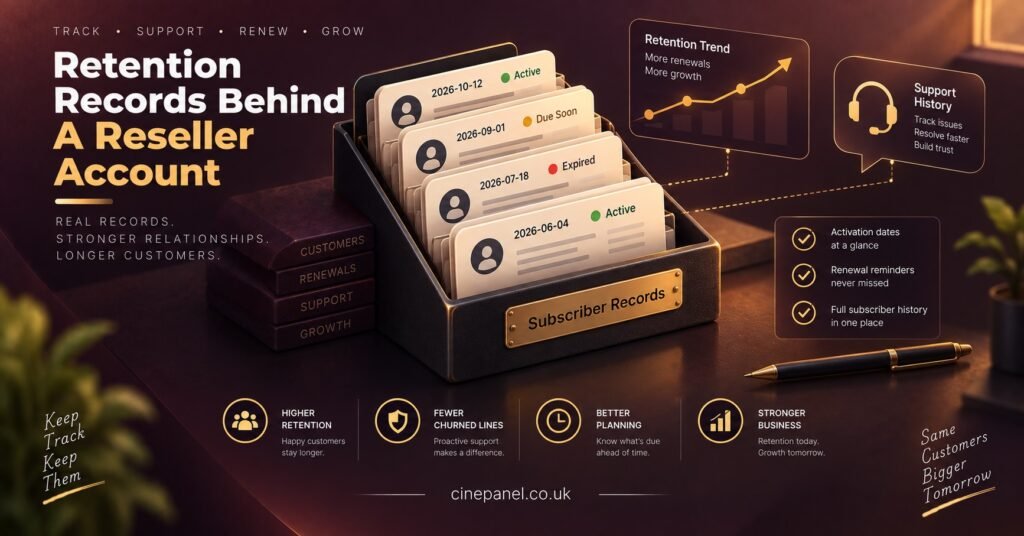
Keep a simple record outside the panel with the customer’s name, activation date, device and app, connection allowance, expiry date, last support contact, and renewal history. A spreadsheet is enough. The value is not in the tool, it is in being able to answer three questions instantly: who expires this week, who has had a fault in the past month, and who has renewed more than once.
That third group deserves attention. Repeat renewers are your most stable revenue and the most likely source of referrals, and they are also the group most resellers ignore because they cause no problems.
Credit planning belongs in the same record. Running short on credits during a renewal week forces you to either delay a customer or scramble, and both are visible to the buyer. Resellers working through a proper IPTV reseller panel and credit system can usually see credit balance and expiry data in one place, which removes the guesswork from restocking before a heavy renewal period.
If you run sub-resellers beneath you, apply the same principle upward. Sub-reseller retention is driven by margin clarity, predictable credit availability and how quickly you answer their escalations, because their customers’ complaints eventually arrive on your desk. A sub-reseller who cannot get a straight answer from you within a working day will start quoting other panels within a month.
Why Discounting Usually Makes Churn Worse
The instinct when a customer hesitates at renewal is to cut the price. It works once. The problem is what it teaches.
A discount given in response to hesitation trains the customer to hesitate every cycle, and it attracts the segment of the market that moves on price alone. Those buyers are genuinely difficult to keep, because someone will always undercut you, and the reseller who wins them on price loses them on price a few months later.
Longer terms are a more defensible answer. A twelve month plan at a modest saving removes eleven renewal decisions from the year, which is a real retention gain. The trade-off is exposure: if your upstream provider becomes unreliable mid-term, you are holding money against a service you cannot guarantee. Only sell long terms on infrastructure you have been running on long enough to judge, and keep enough margin to absorb a refund if you need to make one.
Pro tip: If you do offer a loyalty rate, attach it to tenure rather than complaint. Reward customers automatically at their second or third renewal instead of reactively when they threaten to leave.
Being Honest About What You Cannot Control
Some churn is not a failure of your operation. Households cancel subscriptions during tight months. Devices age out of app support. People move, change connections, or simply stop watching as much. Chasing those customers with repeated offers damages your reputation more than losing them does.
What you can control is whether the exit is clean. A customer who leaves on good terms, with their questions answered and no outstanding dispute, is a realistic return in six months and a safe person to mention you to someone else. A customer who leaves after being ignored tells a different story.
It is also worth being candid about the boundaries of your role. You are supplying access to a delivery platform and the account management around it. You are not the rights holder for what travels across it, and any claim that implies otherwise will eventually be tested by a customer who asks a direct question. Conservative, accurate descriptions of your service protect retention precisely because they never need correcting later.
Frequently Asked Questions
How far ahead should a renewal reminder go out?
While the service is still running, not after it stops. A reminder that arrives with several days of viewing left gives the customer time to act without pressure, and a second short nudge on the day before expiry catches anyone who set it aside. Once the line is dead, response rates fall sharply because the customer has already had to think about alternatives.
Should I give free days when there has been a service problem?
Sometimes, but not automatically. Compensation works best for outages that were prolonged and clearly on your side of the chain. Handing out credit for every minor stall trains customers to report faults as claims, and it devalues the gesture when you genuinely need it. A clear explanation and a confirmed fix satisfies most people.
Do annual plans actually improve retention?
They improve measured retention because fewer decisions are being made, which is a real benefit. They do not improve satisfaction on their own. If the underlying service disappoints, an annual customer simply becomes a refund request rather than a quiet non-renewal, so treat long terms as a reward for stability you already have rather than a way to create it.
What should I do when a customer disappears without explanation?
Send one short, plain message asking whether anything went wrong, with no offer attached. The reply tells you something useful about your own operation even when the customer does not return. Repeated promotional follow-ups after silence rarely recover anyone and often get you blocked.
Is it worth tracking retention at all with a small customer base?
Yes, and it is easier at small scale. With a modest list you can see individual patterns directly: which devices generate the most tickets, which onboarding wording leads to disputes, which months bring the heaviest expiry load. Those observations shape how you sell before the list grows large enough to hide them.
Renewal Window Checklist
- Expiry list reviewed at the start of each week, not the end
- Reminder sent while the line is still active, with date, price and one payment route
- Credit balance checked against the coming week’s renewals before restocking
- Any open fault ticket closed with a confirmation message before the renewal message goes out
- Connection limits and device details confirmed for customers who changed equipment recently
- Second and third time renewers identified and treated as your referral base
- Lapsed lines contacted once, briefly, then left alone
- Reasons for non-renewal recorded in plain language, even when the answer is a guess
Closing Thought
IPTV Reseller Panel Customer Retention is not a marketing exercise bolted onto the end of a sale. It is the sum of a clean setup, a support channel that answers, records you actually maintain, and a renewal reminder that reaches the customer before the screen goes dark. None of those require a bigger budget, and all of them fail quietly if nobody owns them.
Start with the least glamorous part. Pull your expiry dates for the next fortnight, check which of those customers has heard from you since activation, and message the ones who have not. That single habit tends to surface more recoverable revenue than any new campaign, and it costs you an hour.
[…] is a harder look at where your credits come from. When you are comparing options, look for a stable UK IPTV reseller panel with clear credit terms and ask how incidents are communicated to […]