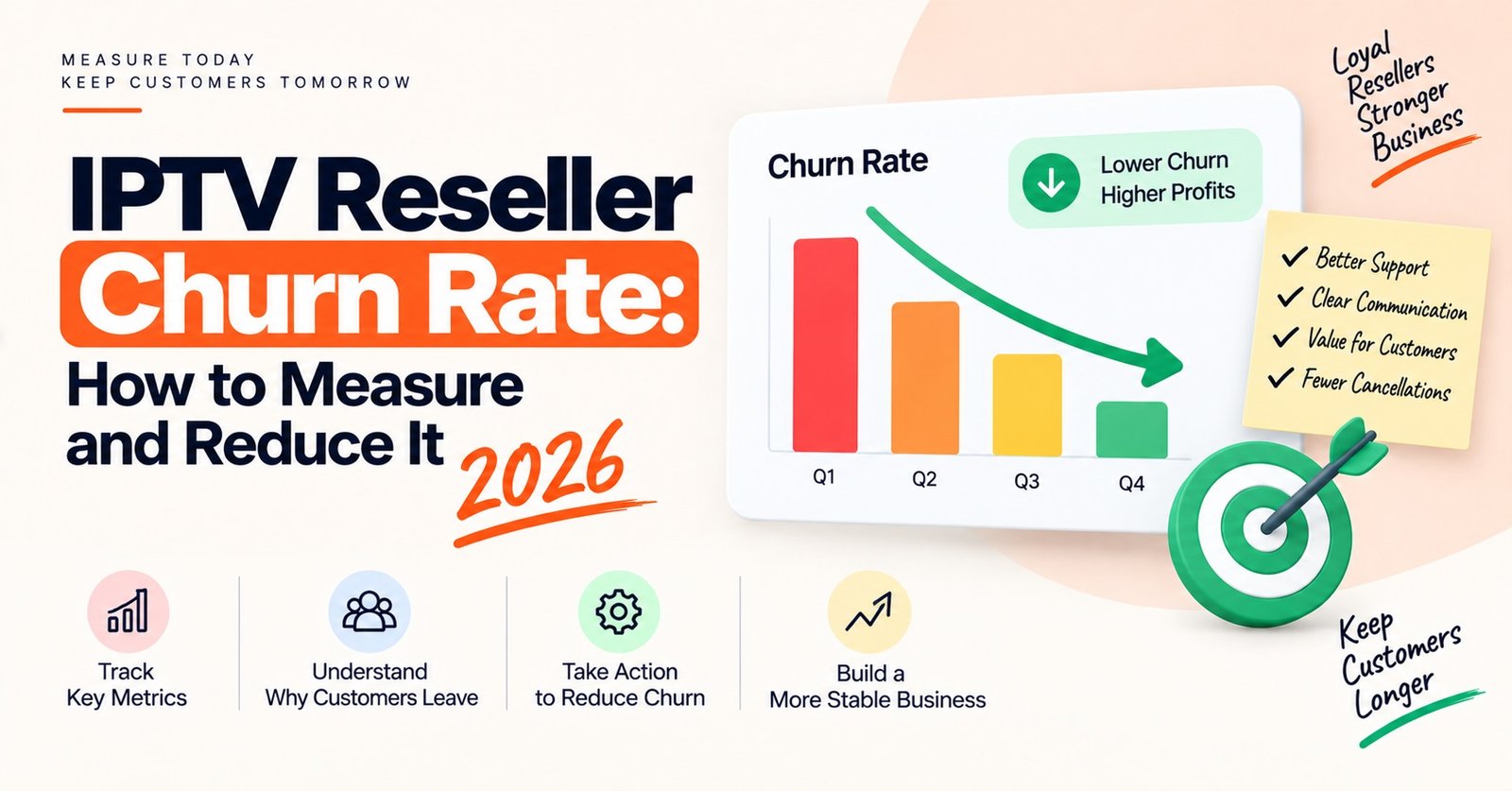
Your IPTV Reseller Churn Rate is the share of customers whose lines came up for renewal in a given period and were allowed to expire. Work it out by counting the lines that were due in a month, noting how many lapsed without renewing, and dividing the lapsed number by the total that were due. That single percentage tells you whether your business is growing or just replacing the customers it loses.
The mistake most sellers make is dividing by their whole active base. A customer on a 12-month line cannot leave you in month four, so counting them dilutes the figure and makes a weak month look healthy. Measure against the lines that were actually due, keep free trials out of the calculation, and you end up with a number you can act on rather than one that simply looks reassuring.
How to Calculate IPTV Reseller Churn Rate From Your Panel
Most UK IPTV panel reseller dashboards show each line’s expiry date, and that is all you need to start. At the beginning of each month, list every paid line set to expire during that month. This is your renewal cohort. At the end of the month, plus a short grace window, check which of those lines were extended.
The formula is simple:
Churn rate = lines not renewed ÷ lines due for renewal × 100
As an illustration, if 80 lines were due in March and 62 were renewed within your grace window, 18 lapsed. Eighteen divided by 80 gives a churn rate of 22.5% for that cohort. The numbers here are only an example; your own will depend on your customer base, plan mix and supplier.
The grace window matters more than people expect. Many customers renew a day or two after expiry because they only notice when the service stops. If you count them as lost on day one, your figure will be inflated and you may start fixing a problem that does not exist. Pick a window, perhaps seven days, and keep it the same every month so the numbers stay comparable.
Three other rules keep the calculation honest:
- Leave trials out entirely. A trial that does not convert is a sales result, not churn, and mixing the two hides both.
- Count customers, not connections. A household with a multi-connection line is one customer, and losing them is one loss.
- Treat a customer who returns after the grace window as a new sale. Otherwise your churn history rewrites itself every time someone comes back.
Pro tip: When a customer renews, note the plan length they chose alongside the old one. Over a few months this shows whether people are trading down to shorter plans, which is often the first sign of trouble before anyone actually leaves.
Customer Churn and Credit Churn Are Not the Same Number
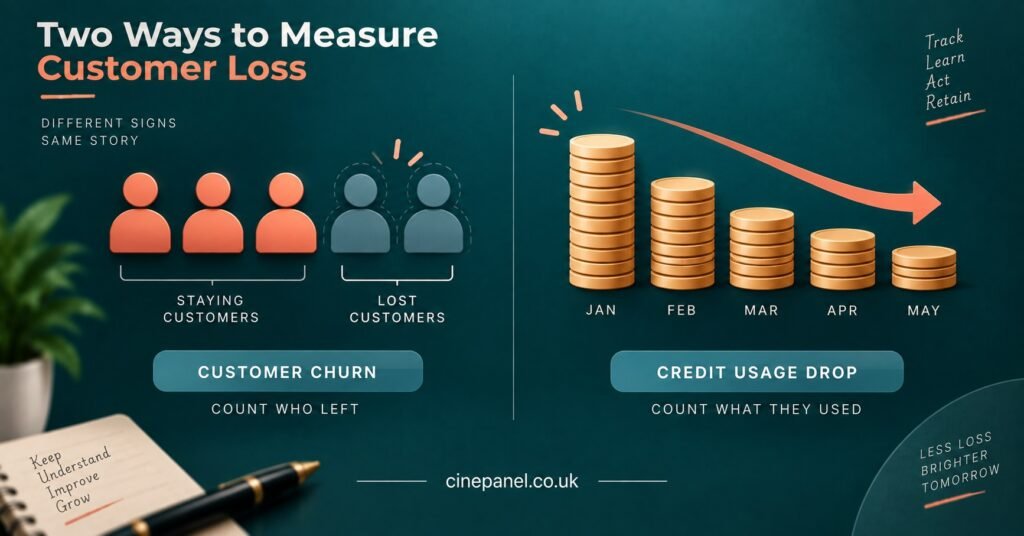
Customer churn counts people. Credit churn counts what you actually spend and earn. A customer who moves from a 12-month line to a 1-month line has not left, yet the credits flowing through that account have dropped sharply.
This matters because IPTV credits are your stock. If your customer churn is steady but your credit usage per renewal is falling, your income is shrinking even though your headcount looks stable. Tracking both side by side takes a few extra minutes a month and stops you misreading a quiet decline as a good month.
The reverse can also happen. Losing a handful of monthly customers while several others move up to longer plans can leave your credit position stronger than the headline churn figure suggests.
Where Customers Actually Drop Off
Churn is rarely spread evenly across your customer list. It tends to cluster at a few predictable moments, and each one needs a different response.
The first few days after activation
A customer who struggles with setup, sees buffering on their first evening or cannot find the guide is already halfway out of the door. They may not complain; they simply decide not to renew. This is why first-renewal churn is often much higher than churn among long-standing customers. A short check-in after activation, asking whether the app is installed and working, catches most of these problems while they are still easy to fix.
The first renewal
This is the real test of whether the customer trusts you. Anything that went wrong during the first plan gets weighed up here. Customers who had one bad weekend and never heard from you tend to leave. Customers who had the same bad weekend but received a clear explanation and a prompt fix often stay.
Long-standing customers
When someone who has renewed several times leaves, the reason is usually price, a competitor’s offer, a change in their household, or a slow build-up of small frustrations. These losses are quieter and harder to spot because long-term customers rarely raise issues. The only reliable signal is often the expiry list itself.
Reading the Signals Behind a Rising Figure
A churn percentage tells you something is wrong. It does not tell you what. Looking at which customers left, and when, usually narrows it down quickly.
| Pattern you notice | What it usually points to | Where to look first |
|---|---|---|
| Losses across every plan length in the same month | A supplier-side incident such as an outage or unstable streams | Your support messages from that period and the supplier’s service notices |
| Losses concentrated among first-renewal customers | Onboarding or setup problems | Your setup instructions and the devices those customers use |
| Customers renewing, but a few days after expiry | Weak reminders rather than dissatisfaction | When and how you send renewal reminders |
| Several losses on one app or device type | A compatibility or configuration issue | The setup guide you send for that device |
| Downgrades to shorter plans rather than exits | Budget pressure or fading confidence | Whether pricing is clear and whether recent service was consistent |
| Long-term customers leaving without contact | Competitor pricing or accumulated small issues | Your last conversation with each of them |
The value here comes from asking the question every month rather than only when churn feels high. Patterns are much easier to spot across three or four cohorts than in a single bad month.
What Sits With You and What Sits With Your Supplier
It helps to be honest about which causes you can actually fix. As a reseller, you control onboarding, reminders, support response times, pricing clarity and how you handle complaints. Those are the areas where effort reduces churn directly.
Your supplier controls stream stability, server capacity, guide accuracy, panel reliability and how quickly outages are resolved. No amount of good customer service will hold on to subscribers if the underlying service keeps failing. If your churn spikes line up with service problems month after month, the fix is not a better reminder message; it is a harder look at where your credits come from. When you are comparing options, look for a stable UK IPTV reseller panel with clear credit terms and ask how incidents are communicated to resellers.
There is also a wider business risk to consider. IPTV is a delivery technology, and whether a service is lawful depends on the rights and permissions behind the content, along with local requirements. A supplier operating without proper rights can disappear or be disrupted without warning, and when that happens your entire customer base churns at once. No retention strategy protects against that, so the legitimacy of what you resell is part of your churn risk, not a separate issue.
For sub-resellers the dependency goes one step further. Your churn is shaped by your parent reseller’s supplier choices as well as your own service, and you may have little visibility of problems until customers start messaging you.

Renewal Habits That Keep Lines Active
A large share of avoidable churn is simply customers forgetting. Most IPTV subscriptions are prepaid for a fixed period with no automatic renewal, so the customer has to take action. If nothing prompts them, some will let the line lapse and then drift to whoever reaches them first.
A few habits make a noticeable difference. Send a reminder several days before expiry and another the day before, rather than one message after the service has already stopped. Make renewal effortless: tell the customer exactly what to pay, how to pay, and confirm when the line has been extended. Keep one consistent contact point so customers are not unsure where to go.
After renewal, a brief confirmation that the line is active and working closes the loop. It also gives the customer an easy opening to mention any problem before it becomes a reason to leave next time.
Pro tip: Keep a short note for each customer who tells you why they are not renewing. Even a few words, such as “price”, “moved house” or “buffering at weekends”, turn into a useful pattern after a couple of months.
When a Low Churn Figure Is Misleading
A low number is not always good news. If you have only a small number of customers, one or two renewals can swing the percentage wildly, so look at the raw counts alongside the rate.
A fast-growing reseller can also see an artificially low figure. If most of your customers joined recently on long plans, very few are due for renewal yet, and the real test is still ahead. Churn measured only against the lines that were due protects you from this, which is another reason not to divide by the whole customer base.
Finally, watch for customers who technically renew but have stopped using the service. Many panels show recent activity per line. A paying customer who never connects is unlikely to renew again, and a quick message now is far easier than winning them back later.
Frequently Asked Questions
How often should I calculate churn?
Monthly works well for most IPTV panel resellers because it matches the most common plan length and gives you enough data points to spot trends. Very small resellers may find a quarterly view more stable, as long as they still review the monthly expiry list.
Is there a standard churn rate for IPTV resellers?
There is no reliable public benchmark for this market. Churn depends heavily on plan mix, customer type, supplier quality and how actively you manage renewals. Your own trend over time is far more useful than any figure quoted online.
Should a customer who pauses for a month count as churned?
If they come back after your grace window, count the original line as lapsed and the return as a new sale. Keeping this rule consistent matters more than which rule you choose.
Do longer plans reduce churn?
They reduce how often a customer has to decide whether to stay, which spreads your renewal risk. They do not fix the underlying reasons someone might leave, and a customer who has a poor experience on a long plan is still unlikely to renew at the end of it.
Putting the Number to Work
Your IPTV Reseller Churn Rate is only useful if it is measured against the lines that were actually due, with trials excluded and a fair grace window applied. Once the figure is honest, the patterns behind it usually point clearly to either your own processes, such as onboarding and reminders, or to supplier-side problems you cannot fix with better customer service. Start with this month’s expiry list, record why people leave, and review the trend over three or four cohorts before making any large change to your pricing or your supplier.
Monthly Churn Review Checklist
- Pull every paid line due to expire this month from the reseller dashboard
- Apply the same grace window you used last month
- Remove trial accounts before calculating anything
- Count lapsed customers and divide by the total that were due
- Note plan-length changes among customers who did renew
- Check whether losses cluster around a specific week, device or plan
- Compare any spike against your support log for the same period
- Record a short reason for every customer who told you why they left
- Message paying customers whose lines show no recent activity
[…] track also keeps your IPTV reseller panel business sustainable. A basic spreadsheet with trials started, trials converted and the stated […]