
Most lines that lapse do not lapse because the customer wanted to leave. IPTV Reseller Renewal Tracking is the difference between a business that quietly bleeds customers every month and one that keeps almost everyone it activates, because the reseller simply knew a renewal was due before the customer had to remind them.
The mistake is treating renewal tracking as an afterthought, something you glance at when a customer messages to say their screen has gone black. By then the line is already dead, the customer has already tried a competitor’s trial, and you are negotiating to win back someone who was never actually unhappy with the service. Good tracking means the reminder goes out before the expiry, not after it.
Why renewals slip through even organised resellers
It rarely comes down to laziness. It comes down to relying on memory, or on a single spreadsheet column that nobody updates the moment a customer pays late, extends early, or switches from monthly to quarterly. A IPTV Panel reseller running twenty lines can hold most of that in their head. A reseller running two hundred cannot, and the gap between those two numbers is where most churn actually happens.
There is also a timing problem specific to IPTV. Unlike a subscription box or a gym membership, a line does not send its own polite reminder email. The panel knows the expiry date, but unless a reseller actively pulls that information out and acts on it, the customer finds out their access has ended the same way they always find out: the picture stops.
What IPTV Reseller Renewal Tracking actually needs to cover
Tracking is not just a date in a diary. To be useful day to day, it needs to answer four questions at a glance: which lines expire this week, which customers have a history of paying late, which lines are on a trial that is about to convert or lapse, and which sub-reseller accounts are approaching their own credit limits before they can renew anyone underneath them.
A dashboard that only shows “active” or “expired” is not enough on its own. What actually prevents lost customers is a forward-looking view, ideally sorted by days remaining, so the reseller is working from a list of what is coming rather than reacting to what has already happened.
| Method | Best suited to | Limitation |
|---|---|---|
| Manual spreadsheet | Very small books, under 30 lines | Breaks down fast once volume grows or more than one person manages it |
| Panel-native renewal view | Resellers using a dashboard built for this | Only as good as how often it is actually checked |
| External reminder tool or calendar sync | Teams who want automated alerts outside the panel | Extra step to keep two systems matching |
None of these is wrong on its own. The point is picking one and using it consistently, rather than half-tracking renewals in three places and trusting none of them fully.
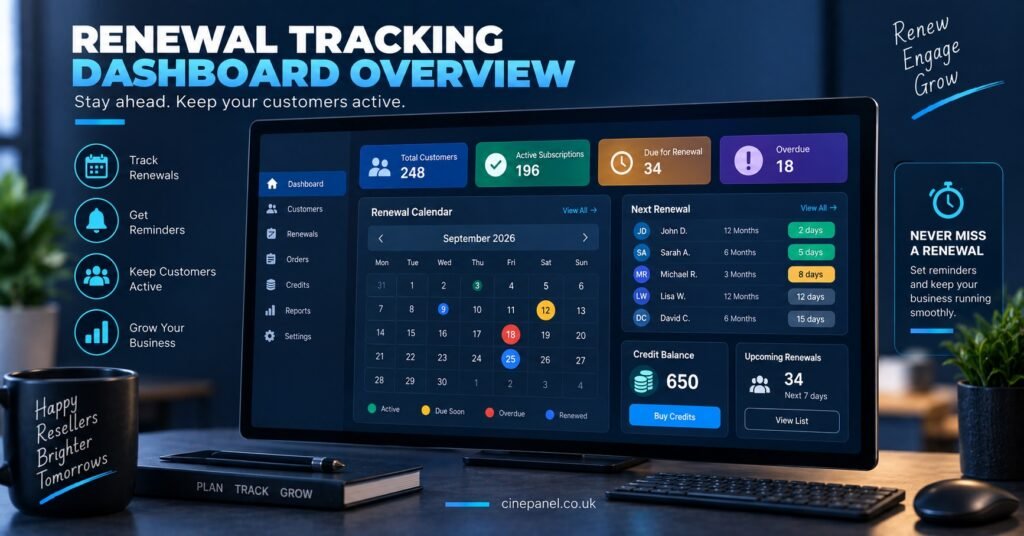
Building a simple renewal calendar without extra software
If a dedicated panel view is not available, a basic weekly routine still works. Pull a list of every line expiring in the next seven and fourteen days at the start of each week, then message those customers before the expiry rather than after. This one habit alone removes most of the “I didn’t know it had run out” conversations that quietly cost IPTV resellers repeat business.
The order matters too. Customers who have renewed late before should be flagged earlier than customers with a clean payment history, since they need more lead time and often more than one nudge. Treating every customer the same way in a renewal message wastes effort on people who would have renewed anyway and loses the people who actually needed the reminder.
Where sub-reseller accounts make tracking harder
A sub-reseller layer adds a second clock. A sub-reseller can run a perfectly organised renewal list for their own customers and still fail if their parent account runs out of credits at the wrong moment. Renewal tracking at this level has to include the sub-reseller’s own credit position, not just the customer expiry dates sitting underneath it.
This is also where visibility gets political. A parent account that cannot see sub-reseller renewal activity is flying blind on a meaningful share of its own churn risk. Panels that let a master account view renewal timing across the whole downstream tree solve this without needing every sub-reseller to report manually.
Pro tip: Set your own internal reminder two or three days before a customer’s actual renewal reminder goes out, so a payment problem or wrong number can still be fixed before the line expires.
Signs your renewal tracking is failing
A few patterns are easy to miss until they add up. Customers messaging to say their line “just stopped” with no warning is the clearest one. So is a reseller repeatedly discovering an expiry only after a customer has already gone quiet for a few days, rather than catching it in advance.
Another quieter sign is inconsistent renewal timing across similar customers. If two people on the same monthly plan renew two weeks apart with no clear reason, the tracking process itself is probably the variable, not the customers.

What to check before assuming a customer has churned
Not every expired line is a lost customer. Some people pay a few days late every single cycle, and treating that as churn on the first missed date leads to reactivating accounts that never actually wanted to leave. Before writing a customer off, check their payment history over the last three or four renewals rather than judging the current gap in isolation.
It is also worth separating trial expiries from paid expiries in any tracking view. A trial that lapses without conversion is a sales outcome, not a support failure, and mixing the two together makes renewal reporting harder to read and less useful for spotting real problems.
Panels built around UK IPTV Panel reseller dashboards for creating and renewing customer lines tend to make this split easier, since active, trial and expired states are usually already separated rather than sitting in one flat list.
Renewal Tracking Questions, Answered
How often should I check renewal status?
Weekly is usually enough for smaller books. Once a reseller is managing more than a hundred active lines, a daily glance at anything expiring within the next three days is worth the extra minute.
Should I renew a line automatically without contacting the customer?
Only if the customer has clearly agreed to that arrangement in advance. Silent auto-renewal without warning tends to generate payment disputes, particularly on cards or bank transfers a customer forgot they had authorised.
Is a spreadsheet good enough for renewal tracking?
For a very small number of lines, yes. Past roughly thirty active customers, most resellers find a spreadsheet starts missing updates, especially with more than one person managing it.
Does credit pricing affect how I approach renewal tracking?
Indirectly. Buying credits in a lower-cost band, such as moving from a starter band to a higher-volume band on a plan like the Cine Panel credit pricing options, often coincides with a reseller finally formalising renewal tracking, simply because the volume makes informal tracking unworkable.
Conclusion
IPTV Reseller Panel Renewal Tracking is not a reporting exercise for its own sake. It is the practical habit that decides whether a customer renews without drama or disappears after one bad week of buffering they never got a chance to fix. Whichever method a reseller chooses, spreadsheet, panel-native view or an external reminder tool, the goal stays the same: know who is expiring before they do, and reach them with enough notice that renewing is the easy option rather than an afterthought.
Renewal Tracking Checklist
- Pull a list of lines expiring in the next 7 and 14 days at the start of each week
- Flag customers with a history of late payment for earlier, repeated reminders
- Separate trial expiries from paid expiries in any tracking view
- Check a customer’s last three or four renewal dates before assuming churn
- Monitor sub-reseller credit balances alongside customer expiry dates
- Set an internal reminder a few days ahead of the customer-facing one
[…] wording matters more than most IPTV resellers expect. A reminder that sounds like an invoice gets ignored; one that sounds like part of the […]