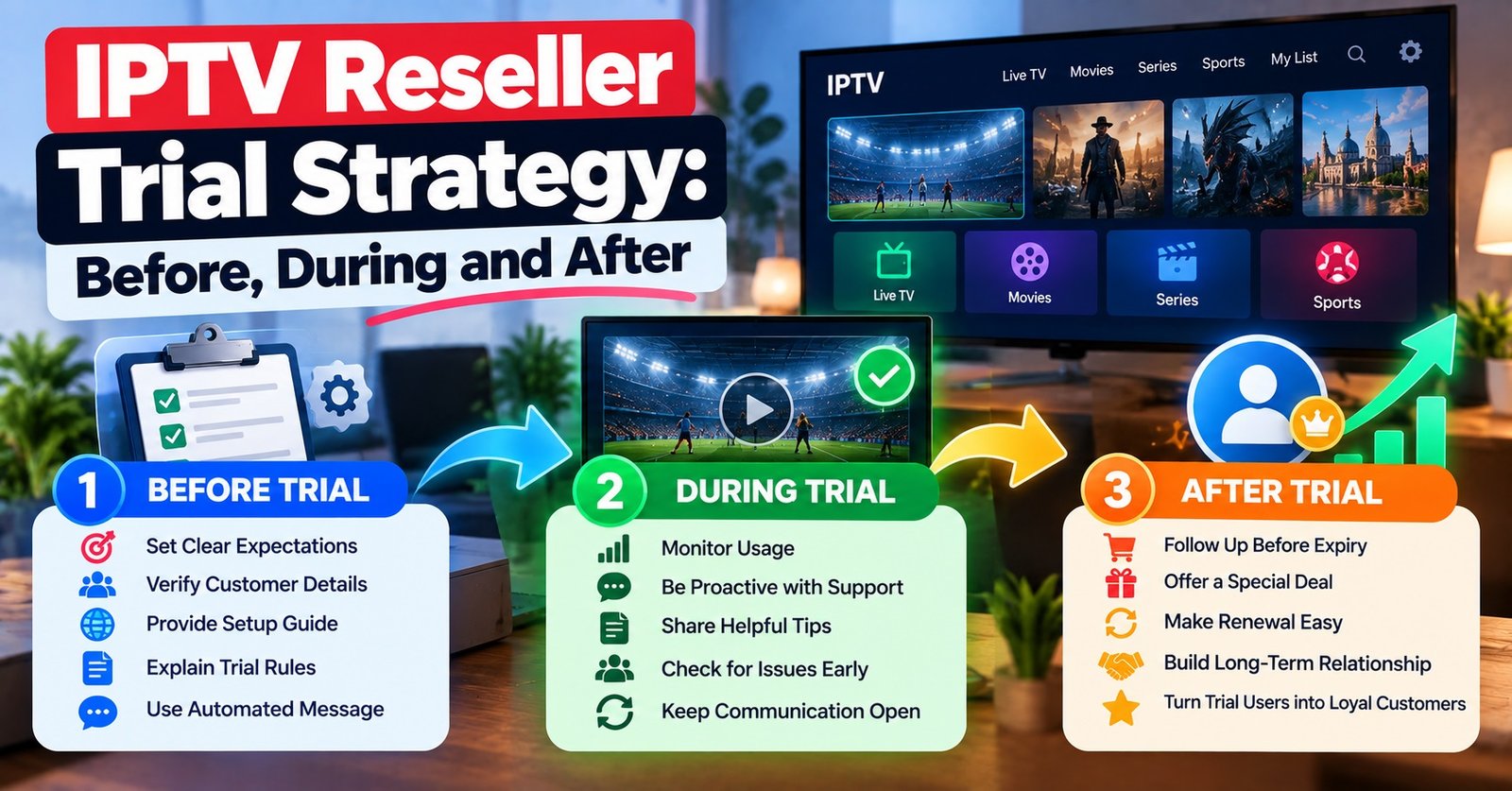
An IPTV Reseller Trial Strategy works when the free test is run as a short, guided sales conversation rather than a login handed over and forgotten. Decide who qualifies before you create the line, get the person watching on their real device within minutes, check in once while the trial is live, and ask for the sale before it expires, not after.
Most test users who drift away were never unhappy with the service. They didn’t finish setup, tested at lunchtime on a weekday when they had nothing to watch, or heard nothing from the seller until the line had already stopped. So before you touch your prices or trial length, look at what happens between creating the trial and the moment it ends. That window is where conversions are won or lost, and almost all of it is in your hands.
A Trial Is a Sales Tool, Not a Free Sample
A free sample assumes the product sells itself. IPTV doesn’t work like that. Its value only shows once it’s installed, configured and used during the hours the person normally watches television. A trial line sent without any context puts all of that work on the customer, who is often not technical and has little reason to persevere with something they haven’t paid for.
It also helps to treat every trial as having a cost. Many panels limit how many trial lines you can create, and every trial takes your time in messages and setup help. Before planning anything, check your supplier’s rules on trial allowances, trial length controls and whether trial lines ever draw on your IPTV credits. If you’re still choosing where to buy from, compare those rules on a UK IPTV reseller panel from Cine Panel against the alternatives, because trial flexibility shapes how you can sell.
The purpose of a trial isn’t to prove your service is flawless. It’s to let a serious buyer confirm three things: it works on their device, it holds up on their connection at the times they watch, and you answer when they need help. That last point decides more sales than resellers expect. The customer is testing you as much as the stream.
Deciding Who Gets a Trial
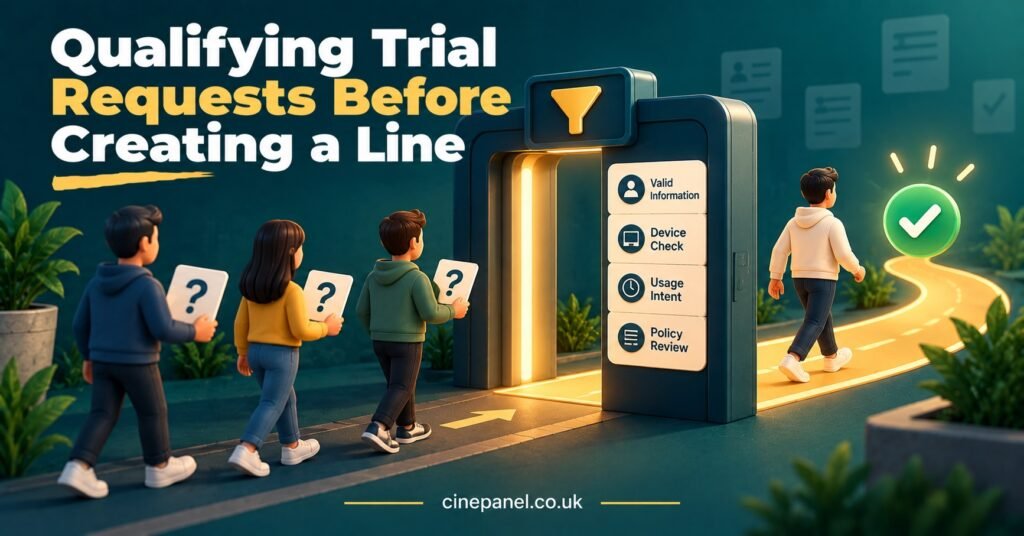
Saying yes to everyone who asks feels generous, but it spreads your time across people who were never going to buy. A few quick questions before you create the line fix most of this:
- Which device will they test on, and is it the one they’ll actually use day to day?
- Is it connected by wifi or cable, and how far is it from the router?
- When do they usually watch, evenings, weekends or both?
- How many screens in the household would need access?
None of this is meant as a barrier. The answers let you send setup steps for the right device and recommend the right plan when the trial ends. Someone who answers readily is usually a real prospect.
Some requests deserve a little caution. A person who wants a trial immediately but can’t say what they’ll watch it on, repeat requests from the same number under different names, or questions that focus only on how long the free test lasts and never on the plans are all signs of trial collecting rather than buying. You can politely decline, or offer a shorter test. Keeping a simple record of each trial (name, contact, device, date and outcome) makes repeat requests easy to spot.
Pro tip: Ask which device they’ll use before creating the line, then send the guide for that device only. One relevant set of instructions gets people watching far faster than a long message covering every platform.
Building an IPTV Reseller Trial Strategy Around the Trial Clock
A trial runs on a timer, so the most reliable approach is to plan your effort around that timer rather than reacting whenever the customer happens to message.
Before the line goes live
Agree a start time. Creating the line hours before the customer sits down to install it wastes part of the test before it has begun. Send the login details and the device-specific setup steps together in one message, so they aren’t hunting through a chat thread for the right information.
The first half hour
This is the window that matters most. Confirm they’ve logged in, that the channel list loads and that the programme guide populates. If you hear nothing once they should have finished installing, send one short message asking whether it loaded on their TV. A lot of silent trials turn out to be setup problems: a mistyped server address, the wrong player app, or a playlist format the app doesn’t handle well.
Midway through
One check-in is enough, and it should invite a specific answer. “How has it been in the evening?” gets more useful replies than “Everything okay?” If they mention buffering, ask about their connection before drawing conclusions. Be honest about what sits at their end and what sits at yours, and don’t blame their broadband by reflex, because customers can tell when a reply is a script.
The final hours
Message before the line expires. Recap what they tested, recommend a plan that matches their screen count, state the price and how to pay, and explain whether they’ll need to set anything up again. Some panels let you convert a trial to a paid line on the same login details, which removes a real point of friction, so check how yours handles it.
After expiry
For trials that ended in silence, send one follow-up a day or two later asking what put them off. Note the reason in your record, then stop. Repeated chasing does more damage to your reputation than one lost sale.
| Trial moment | What often goes wrong | Better move |
|---|---|---|
| Line creation | Created too early, so part of the test expires unused | Create it when the customer is ready to install |
| Setup | Customer stuck on the app or login details | Send one device-specific guide and confirm the first login |
| Mid-trial | Silence, so a small issue becomes the reason to leave | One check-in with a specific question |
| Final hours | No contact until the line stops working | Offer the plan and payment steps before expiry |
| After expiry | Several chasing messages | One follow-up, record the reason, move on |
Pro tip: Keep your check-in and pre-expiry messages as saved templates, but edit each one with the customer’s device and what they told you before sending. A message that mentions their actual setup reads like support, not marketing.
Timing the Test to When People Actually Watch
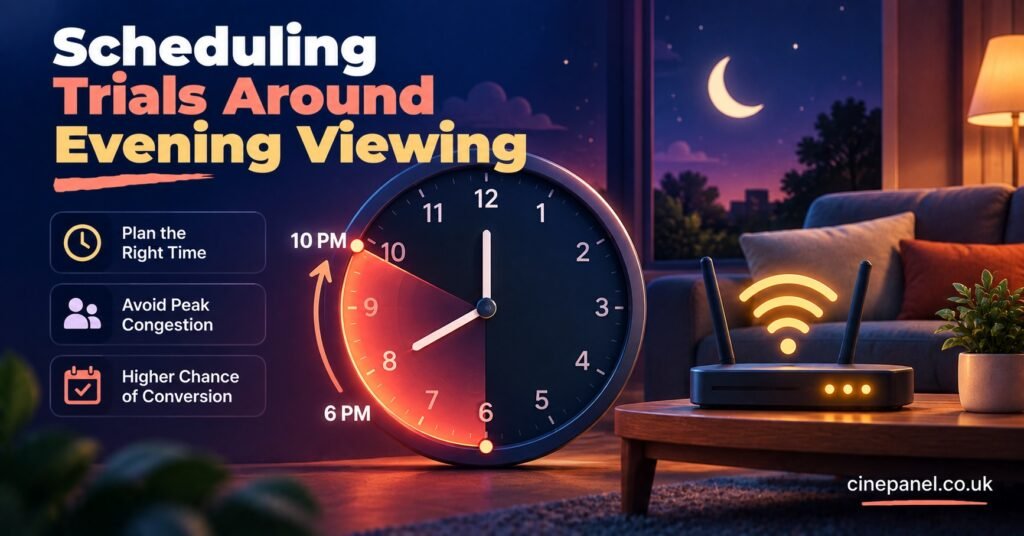
A trial started on a weekday morning tests the least representative hours of the week. Evenings are when home networks are busiest and when streaming infrastructure carries the most load, and that is exactly the period a customer needs to judge. Suggesting a late afternoon or early evening start means the test covers at least one normal evening of viewing.
If you sell across English-speaking countries, the same logic applies in local time. A customer in Ireland, North America or Australia needs their own evening covered, not yours, so agree the start time in their time zone and be ready to reply during their hours. A trial where the customer waits half a day for a support answer has effectively told them what paid service will feel like.
Some customers want to test around a particular live event. You can schedule the trial to suit, but avoid promising specific programming. What any service carries depends on the rights and permissions its provider holds, and that can change. Promising content you can’t guarantee turns a satisfied trial into a refund request a month later.
Asking for the Sale Without Pushing
The close should feel like the natural end of the conversation you’ve been having. Use what you learned during qualification: if they mentioned three screens, recommend a plan that covers three screens, not your most expensive one. Be clear about price, duration, the number of connections and your refund terms. Clarity reassures people far more than enthusiasm does.
For hesitant customers, a shorter first paid term is often an easier yes than a long commitment. Be careful with discounts, though. If every trial ends with a price cut, word gets around and people learn to wait for it.
When someone says no, ask what would have changed their mind. The answers usually fall into a handful of groups: price, reliability at peak times, setup difficulty or simply needing more time. Each needs a different reply. Setup difficulty is often fixable with a quick walkthrough. Reliability concerns deserve an honest look at whether the problem was their connection or the service. Price objections sometimes mean you recommended the wrong plan.
Keeping Trials Honest and Sustainable
A trial builds trust only if what you say during it holds up afterwards. Avoid claims like guaranteed buffer-free viewing or content counts you can’t verify. IPTV is a delivery technology, and whether the content behind it is legitimate depends on the rights held by whoever supplies it. As a reseller, you’re responsible for knowing what you sell and for meeting the requirements where your customers live.
Keeping track also keeps your IPTV reseller panel business sustainable. A basic spreadsheet with trials started, trials converted and the stated reason for every non-conversion is enough. Review it each month. Patterns appear quickly: one device type that keeps struggling with setup, trials started at the wrong time of day, or a particular objection that suggests your pricing or plan structure needs another look.
Pro tip: Give every lost trial a single reason tag, such as setup, price, performance or no reply. One tag per trial keeps the record quick to fill in and makes monthly patterns obvious.
Questions Resellers Ask About Trials
How long should an IPTV trial last?
Long enough to cover at least one normal evening of viewing on the customer’s own device and connection. Check what lengths your panel allows. Longer isn’t automatically better, because attention fades and the urgency to decide disappears.
Is it worth charging a small fee for a trial?
Some resellers do, because a paid test filters out people who were never going to buy. The trade-off is fewer trial requests overall. If free trials are draining your allowance and your time, a small fee or a free trial limited to one per household are both reasonable options to test.
What should I do when a test user reports buffering?
Ask which device they’re on, whether it’s on wifi or cable, and what time the problem appeared. Try a wired connection or moving closer to the router before assuming a service issue. If the problem persists at a time when other customers are fine, raise it with your supplier’s support rather than guessing.
Can a trial line be turned into a paid subscription?
It depends on the panel. Some let you extend or convert the same line, so the customer keeps their existing setup. Others require a new line with new details. Know which applies before you promise either outcome.
How do I stop people abusing free trials?
Keep a record of every trial with contact details and device information, ask qualifying questions before creating a line, and apply a clear one-trial-per-household rule. Most repeat trial seekers move on once they notice the questions.
Making Your Next Trial Count
A dependable IPTV Reseller Trial Strategy comes down to qualifying the request, controlling when the line starts, being present during the first half hour, checking in once, and making the offer before the timer runs out. None of it requires a bigger trial allowance or a discount, only a planned sequence and a record of what happens.
It has limits. No trial approach rescues a service that struggles at peak times, and the tools you have depend on how your panel handles trial lines. A good next step is to look back over your recent trials, note where each one went quiet, and fix the earliest point of drop-off first.